
Ten Wijngaerde Beguinage
South of the old town, whitewashed houses surround a garden shaded by tall trees. For centuries, women lived here in their own religious community. The houses remain inhabited today.
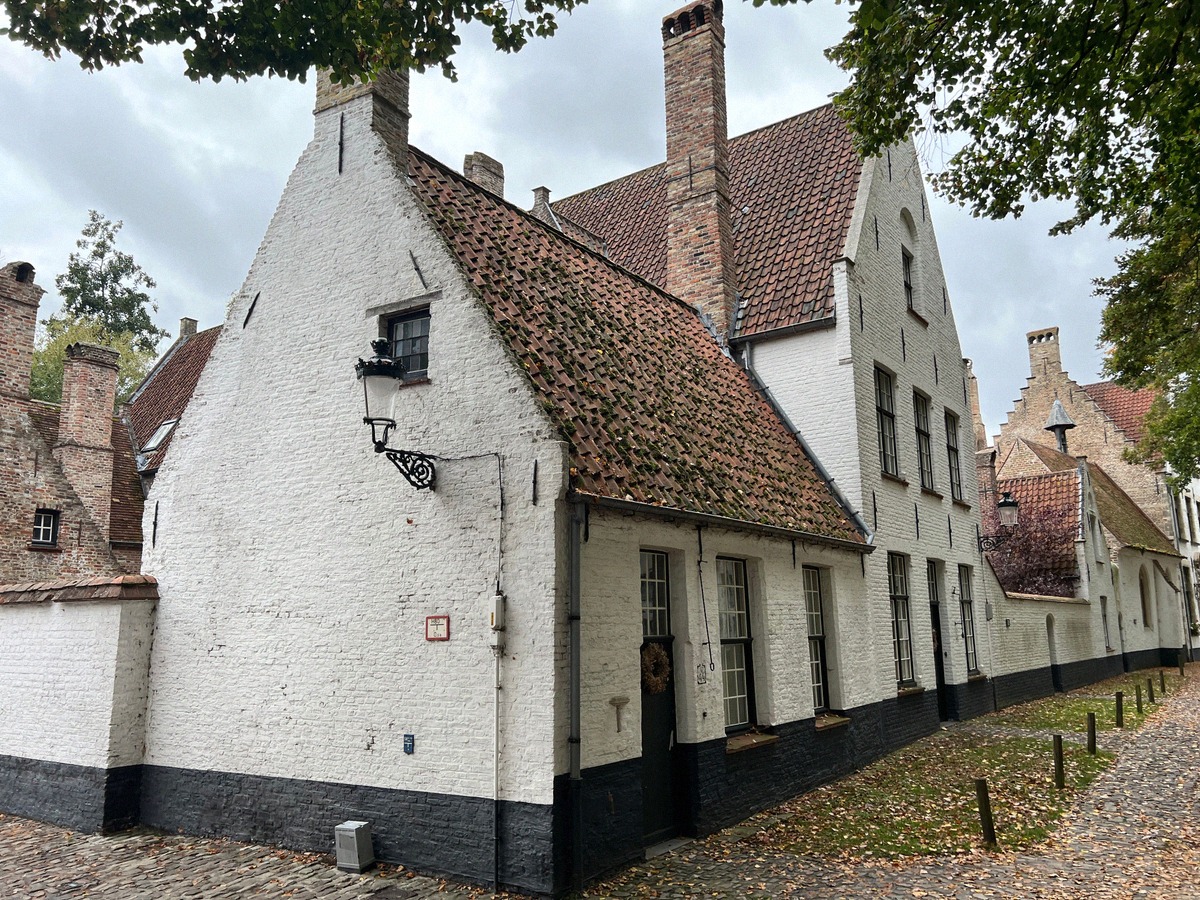
Around the central garden
How the beguines lived
The women who lived at Ten Wijngaerde from the Middle Ages onwards chose a religious community without taking lifelong monastic vows. Some cared for the sick, taught or worked with textiles. Their individual houses stood close together, and they gathered for prayer in the courtyard church.
Unlike women in a strict monastic order, beguines could keep their property and leave the community. Widows also joined. The beguinage provided a protected setting for an independent religious life. In Bruges, it was under the protection of the Countess of Flanders. In 1299, King Philip IV of France placed it under his jurisdiction, the origin of its title “Princely Beguinage”.
The beguines’ history differs from the site’s present use. The last four Bruges beguines joined a community following the Rule of St Benedict in 1927. Today, nuns and single women live here.
One house still stands apart: number 30 has a Baroque façade overlooking the garden. This was the home of the Grand Mistress, who led the community. It also housed the administration and infirmary. Since 1998, the Bruges beguinage has formed part of a UNESCO World Heritage Site together with twelve other Flemish beguinages.
Entering from Wijngaardplein or Minnewater
From Wijngaardplein, a steep bridge leads to the main gate. A second entrance is beside the lock house at Minnewater. This route avoids the bridge, although it too begins on uneven cobblestones.
Inside, paths pass beneath poplars and lime trees between the white houses and the garden. Daffodils flower in spring, followed by wild bluebells. The houses are home to local women and nuns. Visitors can use the paths free of charge, and residents ask that the courtyard be crossed in silence.
The walk continues past the lock house towards Minnewater. In the other direction, Walplein and De Halve Maan brewery lie on the route back into the old town.