
Belfry of Bruges
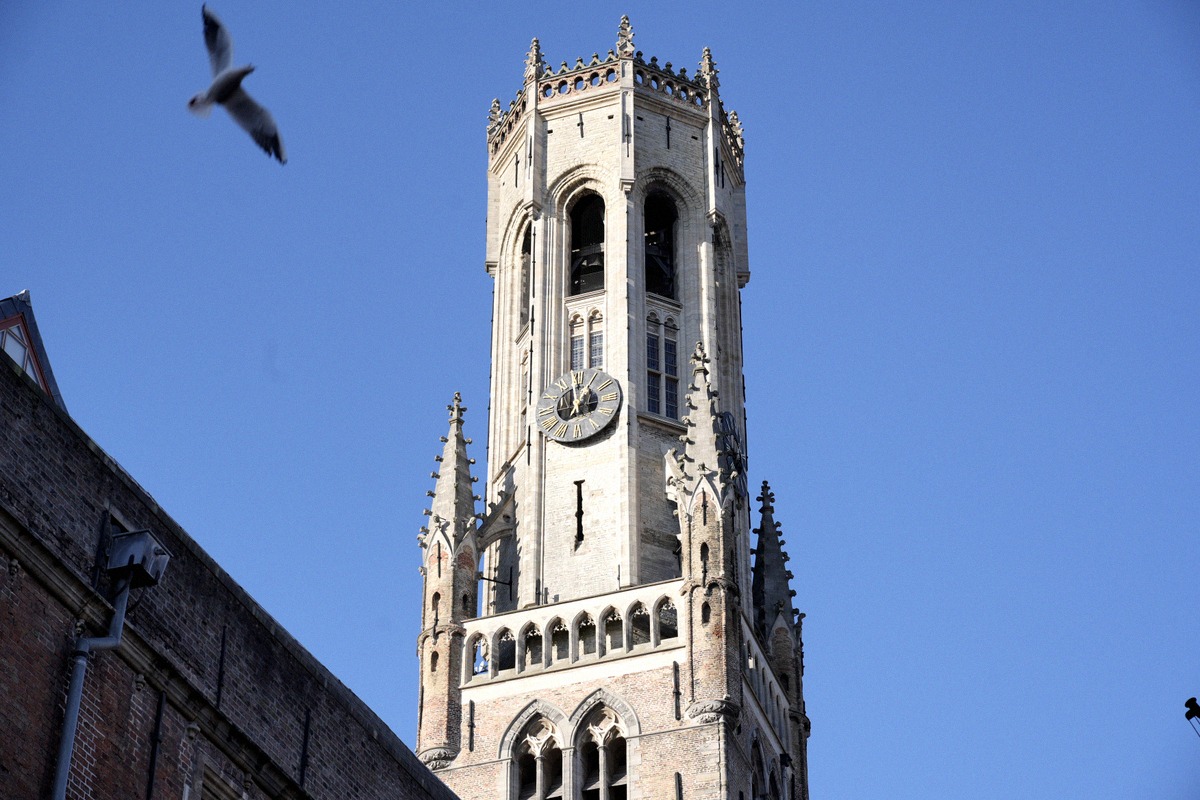
From the Markt, 366 steps lead up the bell tower above the old market halls. On the way up, you can see the instrument whose music reaches the square below.
Inside the Belfry
Why the city built a tower above its market halls
The Belfry stands directly above the market halls. As early as the 13th century, the tower played a role in the life of this trading city. Its bells marked the rhythm of the day and warned of danger. The people of Bruges also kept their city seal, treasury and charters recording their rights here. The treasury built for this purpose is low down in the tower. Starting from the courtyard of the halls, you reach it after just 55 steps.
Fires, rebuilding and a leaning tower
The stone tower was probably built around 1240. A fire damaged it as early as 1280. After repairs, it was raised further in the 14th and 15th centuries. The Belfry acquired its octagonal upper section of Brabant sandstone between 1482 and 1486. Its wooden spire did not survive the following centuries: after repeated fires, this chapter of its construction history ended with the loss of the spire in 1741.
The tower is not quite vertical. It leans approximately one metre to the south-east, towards Wollestraat. Ground conditions are considered the likely cause. Its stability is checked regularly. The lean does not prevent visits to the tower.
Climbing from the courtyard
The staircase becomes narrower and steeper towards the top. Several landings break up the climb. If you want to enjoy the view from the bell chamber, book a time slot, particularly at weekends. If you stay below, you can enter the courtyard of the halls through the gateway facing the Markt.
How the 47 bells are played
Shortly before the top is the chamber containing the large musical drum. This operates the carillon automatically. One floor above, you can see the city carillonneur’s keyboard, from which the 47 bells can be played by hand. Just 14 steps separate this position from the viewing platform.
From above, you can pick out the towers of the Church of Our Lady and St Saviour’s Cathedral among the rooftops. Below, the lanes beside the market halls lead towards the Burg and City Hall and the walking route through the old town.