
Church of Our Lady
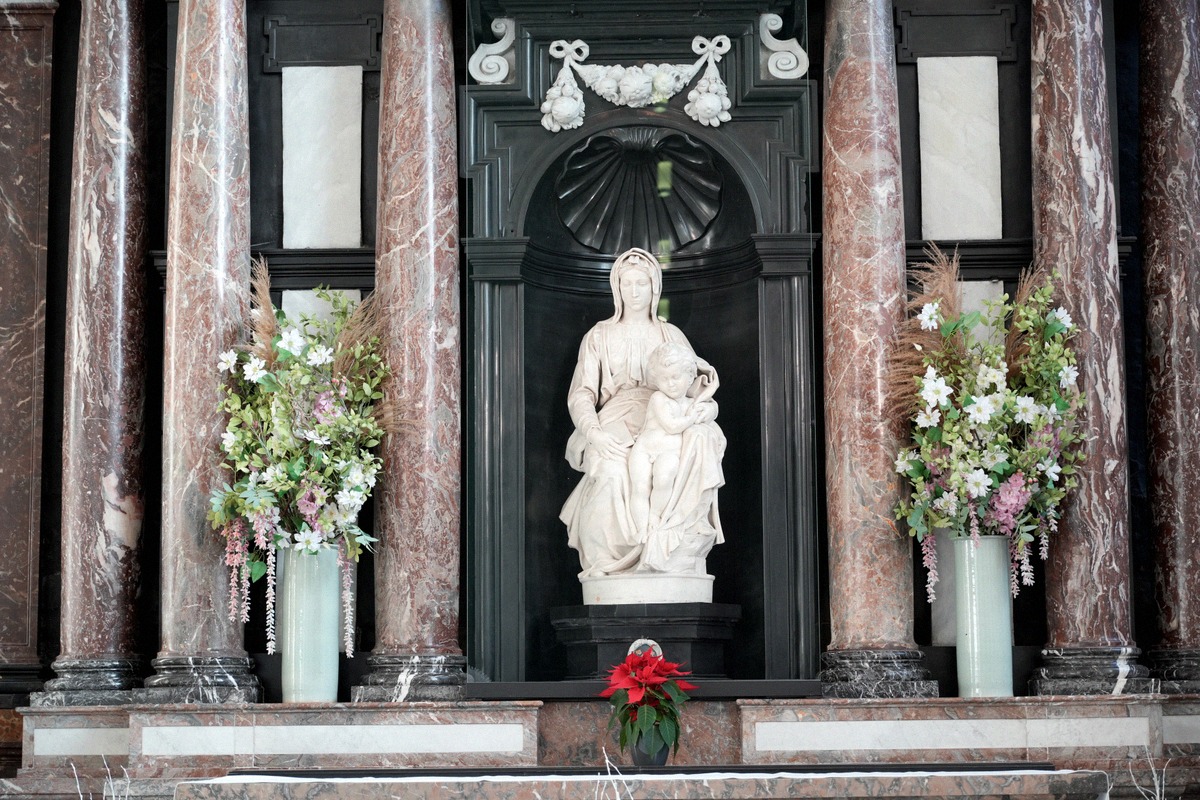
The brick tower of the Onze-Lieve-Vrouwekerk rises above the museum district beside the Dijver. Inside stands Michelangelo’s Madonna and Child, brought from Italy to Bruges during the sculptor’s lifetime.
Inside the Church of Our Lady
From a three-aisled building to a major city church
The oldest part of the present nave dates from the first half of the 13th century. At the time, the nave had one aisle on either side. Work on the choir and tower began later in the same century. Further extensions followed in the 14th and 15th centuries. Today the nave has two aisles on either side. Two round stair turrets frame the doorway on the west side.
Even without visiting the museum, you can trace how the building developed. The great brick tower belongs to a different phase from the aisles added later. Along with St Saviour’s Cathedral, it shapes the southern skyline. Both churches are separate stops on a tour of Bruges’ churches.
Michelangelo’s Madonna and its journey to Bruges
Michelangelo carved the Madonna from white Carrara marble between 1503 and 1505. Mary sits with her gaze lowered. The child stands in front of her, between her knees, holding her hand. The sculpture came from Italy to Flanders during the artist’s lifetime. The Mouscrons, a merchant couple from Bruges, donated it to the Church of Our Lady in 1514 on condition that it should remain there.
The Madonna was taken away twice. During the French Revolution it was moved to Paris, returning to Bruges in 1816. German soldiers looted it in September 1944. After its recovery from an Austrian salt mine, it returned to the church in November 1945.
The high choir and the tombs
The church is free to enter. To see the Madonna and the high choir, you need a ticket for the O.L.V.-kerk Museum. The choir holds the tombs of Charles the Bold and his daughter Mary of Burgundy. Its artworks also include Bernard van Orley’s three-panel painting of the Passion of Christ. A private prayer chapel links the choir with the neighbouring Gruuthuse Palace.
The Church of Our Lady remains a place of worship. Access to the church may close during weddings or funerals. From the square on Mariastraat, you can walk alongside Gruuthuse Palace to the Dijver and on to the Groeningemuseum.